Final Pressure Test – The things you need to know
The Final Pressure Test - Most Gas Heater Installers Skip
The single test that separates a compliant gas installation from everything else — and why most installers avoid it.
Did Your Installer Do a Final Pressure Test?
💬 Licensed Gas Service Worker advice under Regulation 21.
What is the final pressure test?
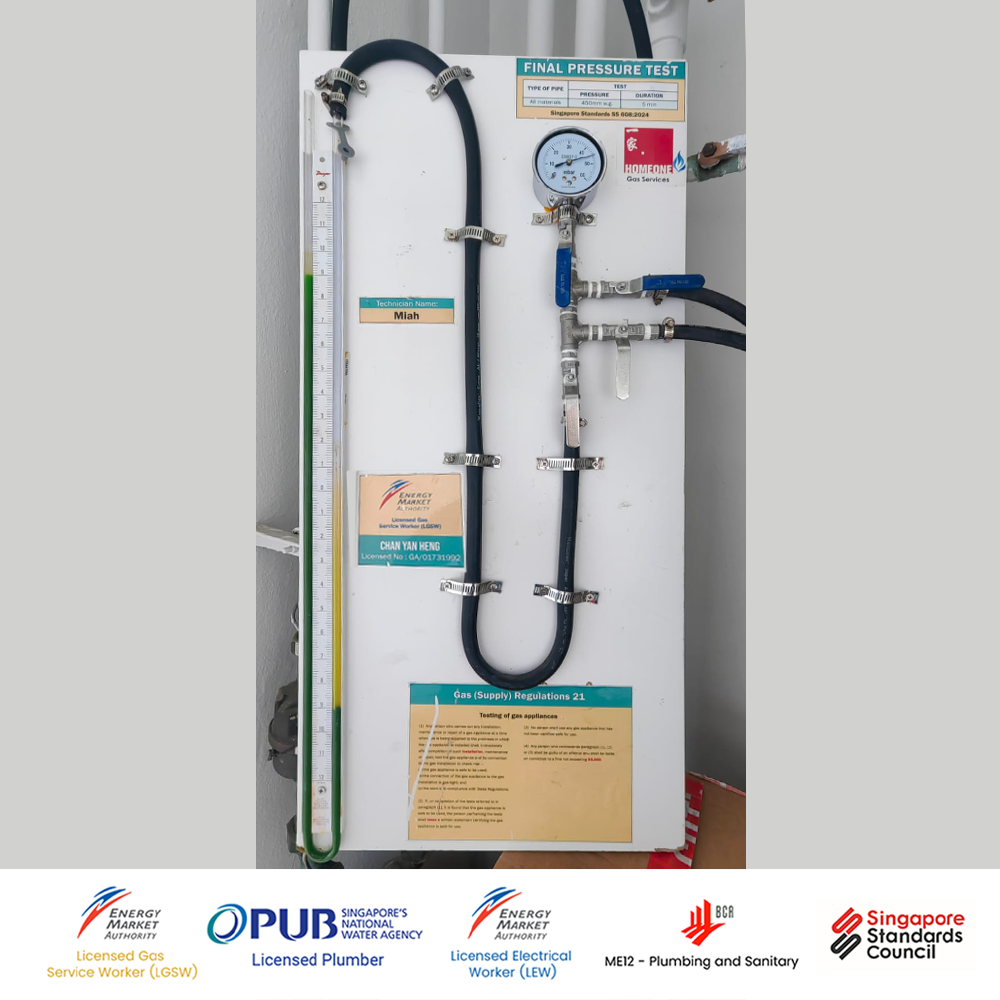
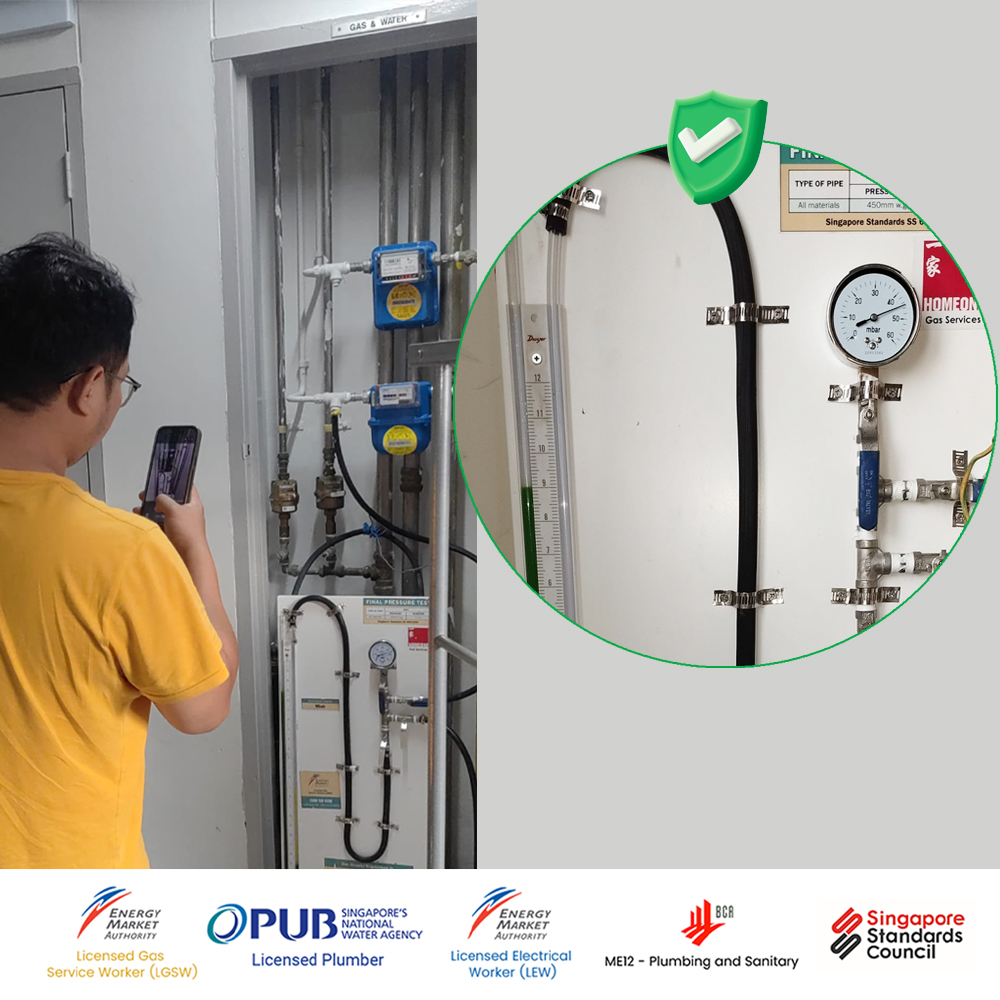
The final pressure test uses a water gauge (manometer) connected to the gas line. The gas system is pressurised to 450mm water gauge and held for 5 minutes. If the water level in the gauge stays steady, there is no leak anywhere in the system. If it drops — even slightly — there is a leak.
The result is binary. The water level holds or it drops. There is no interpretation, no judgment call, no grey area. The customer can stand next to the gauge and see the result with their own eyes.
What does it actually test?
This is the detail most people miss. The final pressure test does not only test the connection at the gas water heater. It tests the entire gas installation in the house.
When the gas line is pressurised, the pressure reaches every connection in the system — the heater connection, the cooking hob connection, the gas meter union, every joint on every pipe between the meter and every appliance. If any of those connections has a leak, the water level in the gauge drops.
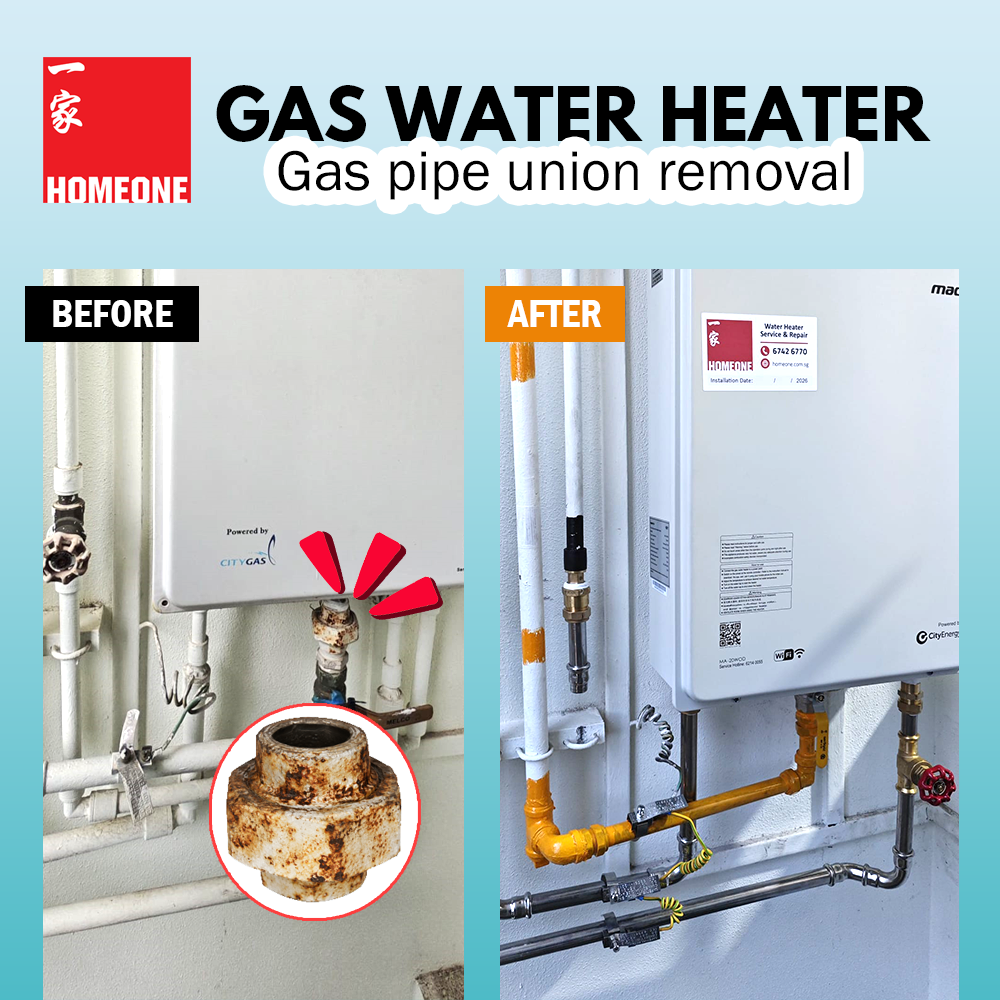
This means Homeone sometimes discovers gas leaks that have nothing to do with the heater replacement. A leaking union at the gas meter, a deteriorated connection at the cooking hob, a slow leak at a pipe joint in the ceiling void — the final pressure test finds all of them in one 5-minute test.
One test catches everything
The final pressure test pressurises the entire gas installation — not just the section Homeone worked on.
If the water level drops, the technician investigates to identify the leak location. If the leak is within Homeone's scope (up to 1 metre from the heater), it is fixed as part of the job. If the leak is outside the scope (at the gas meter, cooking hob, or elsewhere), the technician flags it and advises the customer.
No other test method provides this whole-system visibility in a single pass.
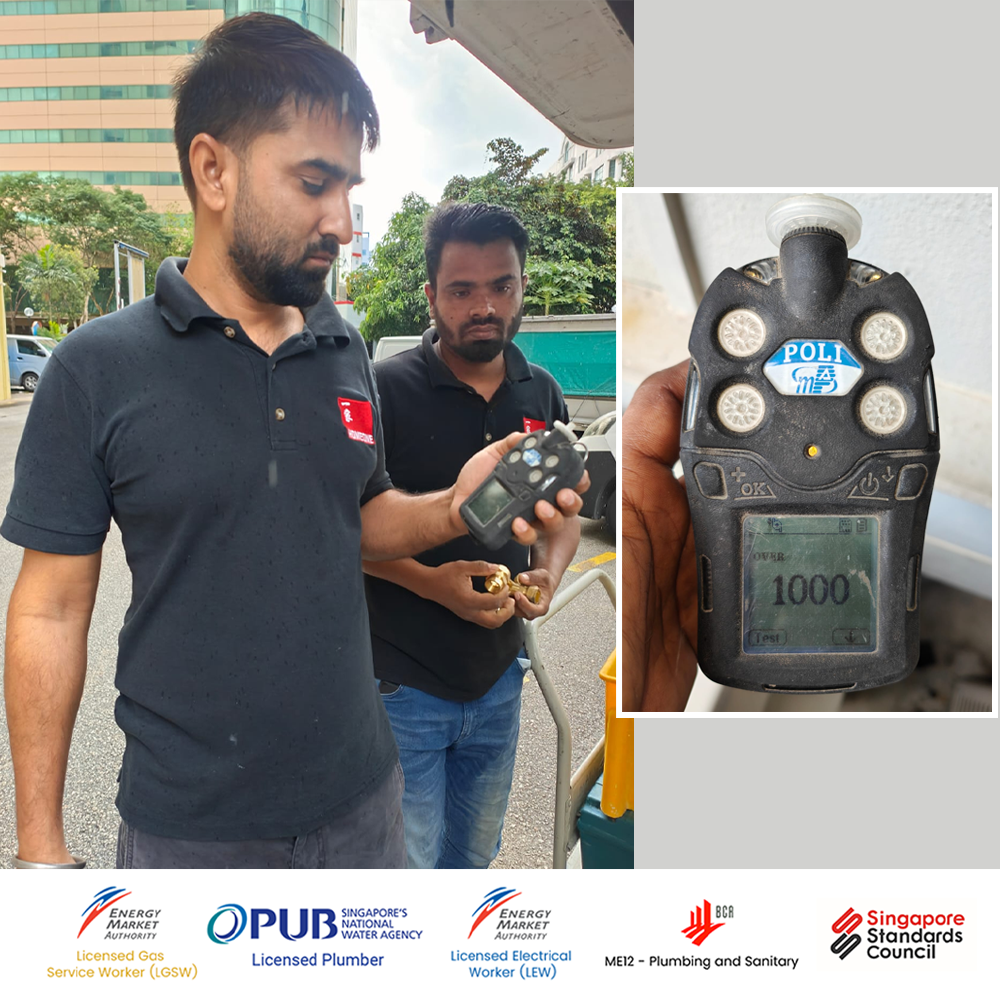
Most other gas heater installers use a handheld electronic gas detector. The technician waves the device near each joint and listens for an alarm or watches a reading on the screen. If the detector doesn’t alarm, the joint is considered safe.
The problems with handheld detection
It tests one spot at a time. The technician must physically move the detector to every joint and hold it there. If a joint is missed — behind a pipe, in a tight corner, at the gas meter — the leak is not detected.
It misses small leaks. Handheld detectors have a sensitivity threshold. Micro-leaks from deformed threads, worn mating faces, or hairline cracks may not trigger the alarm. These micro-leaks are real — they release gas continuously — but they are below the detection threshold of the handheld device.
The result is subjective. The technician interprets the reading. A fluctuating number on the screen, a brief alarm in a windy area, a detector that hasn’t been calibrated recently — all of these introduce human judgment into what should be a binary pass/fail result.
The usage may be more performative than diagnostic. Waving a handheld detector near a joint, hearing no alarm, and issuing a certificate creates the appearance of testing without the rigour of an actual pressure test. The paperwork looks the same. The assurance is not.
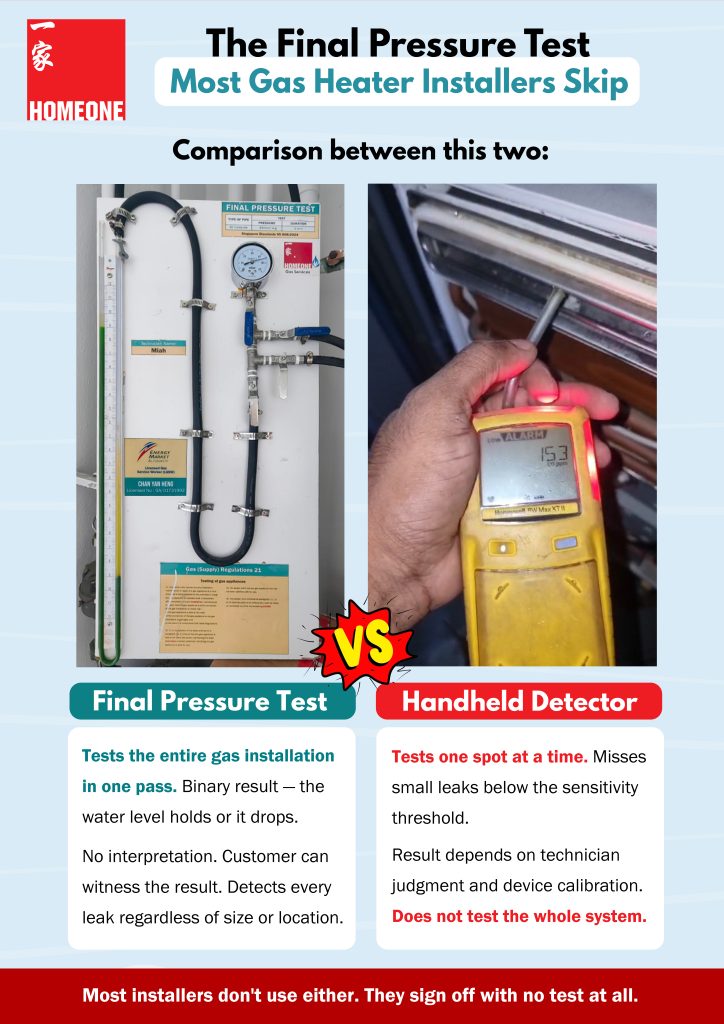
Final pressure test — manometer gauge board
Handheld electronic gas detector
Why most competitors don’t use the final pressure test
The final pressure test is not a secret. Every Licensed Gas Service Worker knows what a manometer is and how to use one. The reasons most competitors use a handheld detector instead are practical, not technical.
The test finds problems they cannot solve
If a leak is detected at the gas meter or cooking hob — outside the scope of the heater replacement — the installer must explain the finding, recommend action, and potentially delay the job. Most installers avoid this entirely by using a handheld detector, which only tests the joints they choose to test.
The gauge is difficult to construct
The manometer gauge board is not mass-produced. It is assembled to specification — approximately 420×900mm, holding the water column, tubing, connections, and valves. Building one correctly requires understanding the test specification.
It costs several hundred dollars
A handheld gas detector costs less and fits in a pocket. The gauge board costs more and must be transported to every job site.
It must be carried to every job
The 420×900mm board must be handled carefully to avoid damage. Lugging it to every job, up staircases, and onto aircon ledges requires discipline that most solo operators and small teams do not maintain.
The standard has been revised — most don't know
SS608:2024 specifies a 450mm water gauge for residential internal pipes. Most competitors who own a gauge are still using the 300mm version that has been around for decades. The revised standard is not easily available, and many operators are unaware it has changed.
Other contractors ask what it is
When Homeone technicians carry the gauge board onto a condominium site, other contractors on the same project routinely ask what it is and how difficult it is to use — because they have never seen one before.
The test specification
The final pressure test for residential gas installations is specified in SS608:2024 Section 8.1.
| Parameter | Specification | Reference |
|---|---|---|
| Test pressure | 450mm water gauge | SS608:2024, Table 2 |
| Duration | 5 minutes | SS608:2024, Table 2 |
| Pipe material | All materials | SS608:2024, Table 2 |
| Gauge scale range | Up to 1.5× test pressure | SS608:2024, Section 8.1 |
| Scope | All internal pipes in residential premises | SS608:2024, Section 8.1.3 |
Fianl Pressure Test: Old Standard SS608:2015
New Standard SS608:2024
Final pressure test vs handheld detector
Final pressure test: Tests the entire gas installation in one pass. Binary result — the water level holds or it drops. No interpretation. Customer can witness the result. Detects every leak regardless of size or location.
Handheld detector: Tests one spot at a time. Misses small leaks below the sensitivity threshold. Result depends on technician judgment and device calibration. Does not test the whole system.
The 450mm standard
SS608:2024 specifies 450mm water gauge for residential internal pipes. This is the current standard. Most competitors who own a gauge are still using the older 300mm version that has been in circulation for decades. The revised 450mm gauge is not easily available in the market. Homeone uses the current 450mm standard on every job.
The report and certificate
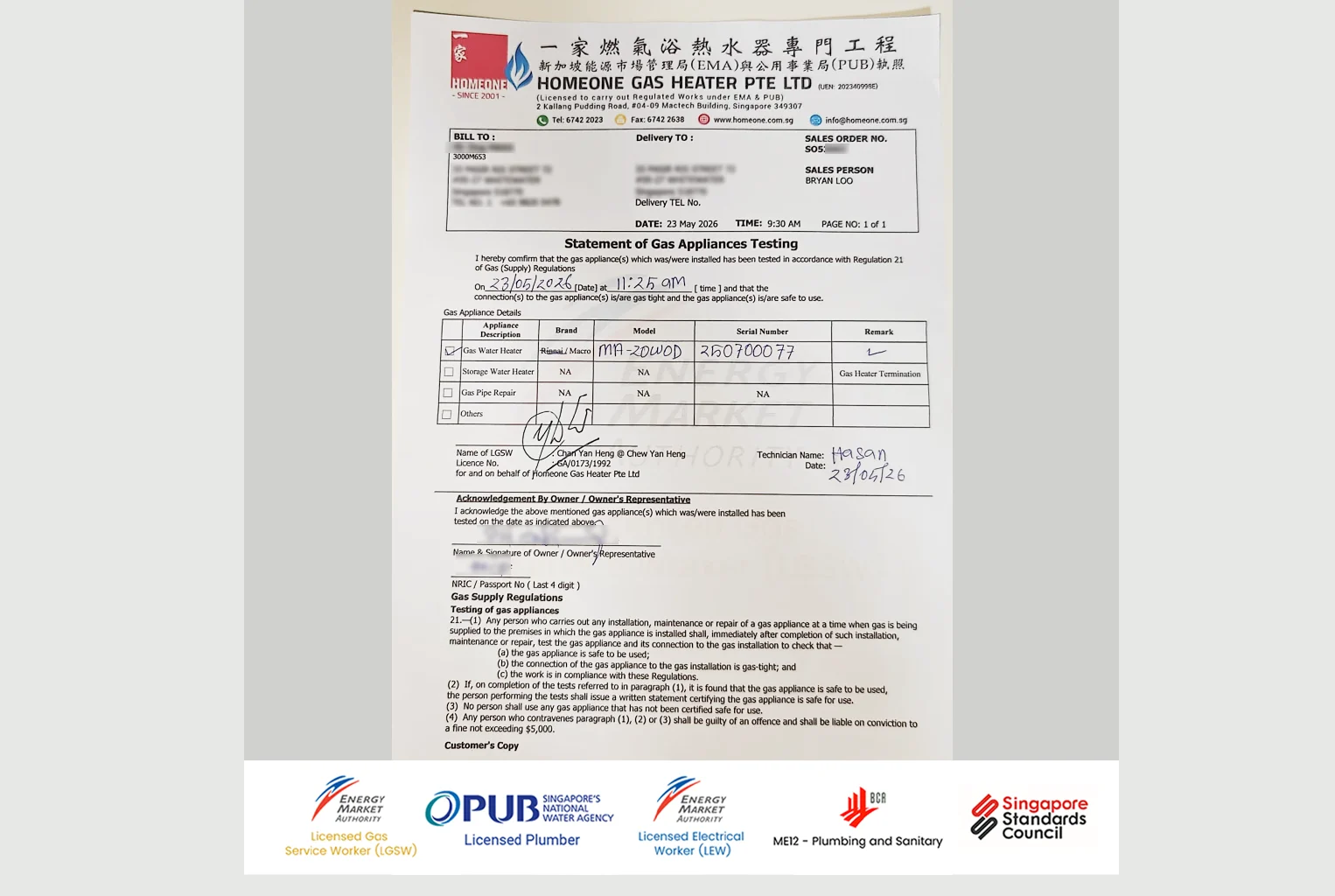
SS608:2024 Section 9.4 requires the competent person who carried out the commissioning to prepare a report certifying that the work is complete and the gas appliances are safe for use. The original copy of the report goes to the customer.
The report must confirm:
i) The installation has been checked and tested for gas tightness
ii) The appliances are properly connected and tested for leak-free condition
iii) The appliances are safe for use and working properly
iv) The customer has been shown the safe and proper way to operate the appliance
This report is the Certificate of Gas Safety (S/N 14 on the quotation). It is the legal document that certifies your gas installation is safe. Under Gas Supply Regulation 21, no person shall use any gas appliance that has not been certified safe for use.
Why the charge is $0.00
The final pressure test is listed at $0.00 on the quotation because it is a legal requirement under Gas Supply Regulation 21. Homeone does not charge separately for complying with the law. The cost of performing the test — the gauge, the technician’s time, the documentation — is built into the overall package price. The test is performed on every gas water heater replacement job without exception. It is not an optional add-on. It is not something the customer can decline. It is what happens before Homeone hands over your gas installation.
Gas Supply Regulation 21
Any person who carries out installation, maintenance, or repair of a gas appliance shall, immediately after completion, test the gas appliance and its connection to check that it is safe, gas-tight, and compliant. A written statement certifying the gas appliance is safe for use shall be issued. No person shall use any gas appliance that has not been certified safe for use. Any person who contravenes this regulation is liable to a fine not exceeding $5,000.
The bottom line
The final pressure test is the single most important step in a gas water heater replacement. It tests not just the heater connection but the entire gas installation in your home. It detects leaks that handheld detectors miss. The result is visible, binary, and witnessed by the customer. Most competitors don’t use it — not because they can’t, but because their work wouldn’t pass it, they don’t want to find problems they can’t solve, and they don’t want to carry a 420×900mm gauge board to every job.
If you are comparing quotes, ask one question:
"Will you do a final pressure test and give me a Certificate of Gas Safety with the test result?"
If the answer is no, the price difference is the cost of work they're skipping.
Call Now +65 6742 6770
WhatsApp +65 88226770
More Articles

Certificate of Gas Safety – Certifies your gas installation is safe