

Gas Pipe Replacement
Understand in depth on why we replace the gas pipe section and all fittings on every gas heater replacement job
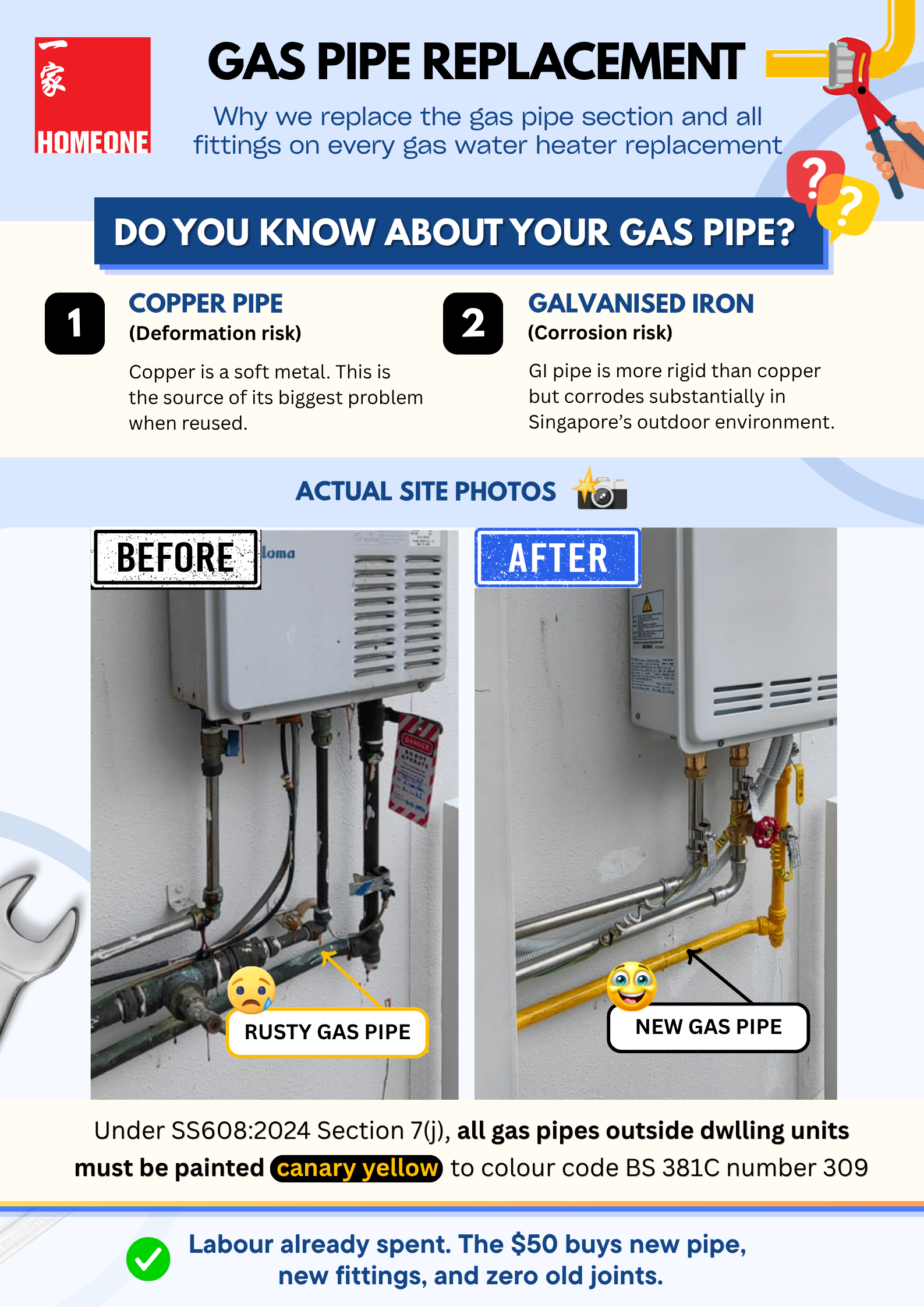
When a gas water heater is replaced, the gas pipe section connecting it to your home's gas supply is almost always left in place. Most installers do not replace it — not because it is unnecessary, but because it saves them time and materials. At Homeone, we replace the gas pipe section and all fittings on every gas water heater replacement, at a fixed additional cost of SGD 50. Here is why this matters.
The Two Pipe Materials Found in Most Homes
Copper is a soft metal. When existing copper gas pipe is disturbed during a heater swap — disconnected, bent, or repositioned — it deforms. A deformed joint no longer seals cleanly.
Reinstalling the old heater's copper flex pipe onto a new unit compounds this risk. The pipe was fitted to the previous appliance's connections. Reusing it introduces mechanical stress at every joint it was previously torqued to.
GI pipe is more rigid than copper and holds its shape under stress. However, it corrodes substantially in Singapore's outdoor environment — particularly at threaded joints and exposed sections.
Corrosion on a gas pipe is not a maintenance issue. It is a structural integrity issue. A corroded GI joint is a joint that is progressively thinning from the outside in. It does not fail visibly until it is already compromised.
What Replacement Actually Looks Like
Under Singapore Standard SS608:2024, all gas pipes outside dwelling units must be painted canary yellow to colour code BS 381C number 309. This is not an aesthetic choice — it is a regulatory requirement that allows gas pipes to be identified and inspected at a glance. An unpainted or incorrectly coloured outdoor gas pipe is a non-compliant installation.
The labour to swap a gas water heater is already being spent. The SGD 50 buys new pipe, new fittings, and zero old joints carried forward into your new installation. It is not an upsell — it is the correct way to complete the job.