

Final Pressure Test - Most gas heater
installer skip
A Certificate of Gas Safety is an official document issued by an EMA-licensed gas worker after inspecting and verifying that your home's gas installation meets Singapore's safety standards.
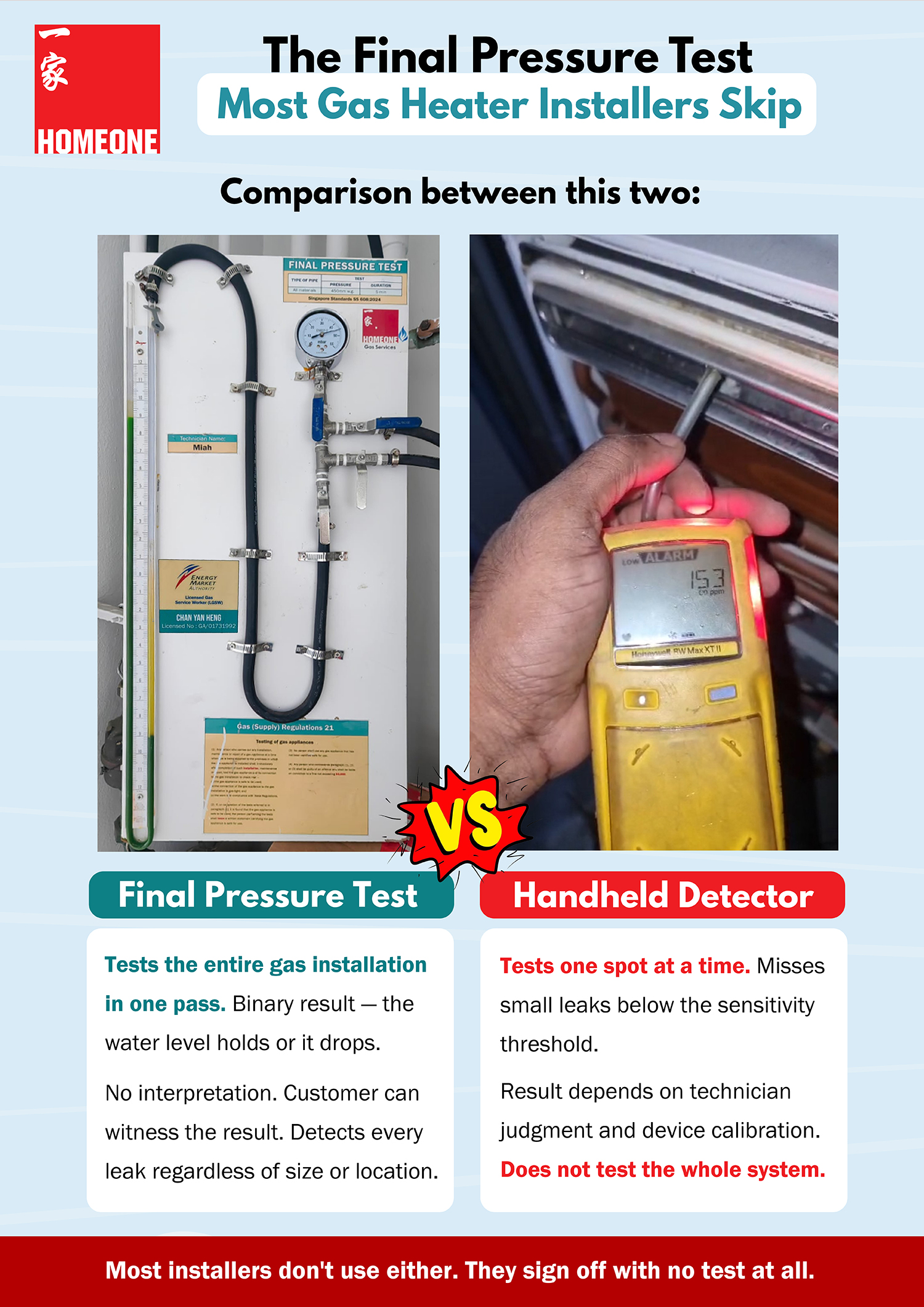
The final pressure test is the definitive check that a gas installation is leak-free. It tests the entire gas pipe system in a single pass — not one joint at a time, not one appliance at a time. Most gas heater installers in Singapore skip it entirely. At Homeone, it is a non-negotiable step in every gas installation job, and the result is shown to the customer directly.
Final Pressure Test vs Handheld Detector
Binary result — the water level holds or it drops. There is nothing to interpret and nothing to adjust for. Either the system holds pressure or it does not.
The customer can witness the result directly. Every leak is detected regardless of size or location in the system.
Misses small leaks that fall below the device's sensitivity threshold. The result depends on which spots the technician chooses to check.
Accuracy varies with device calibration and technician judgment. Does not test the whole system.
How the Final Pressure Test Works
The technician seals the system so it can hold pressure. Every outlet is isolated before the test begins.
Gas pressure is applied to the entire installation. The pressure gauge on the test board records the starting level.
The system is left under pressure for the required duration per Singapore Standards SS 608:2014. The water column is monitored for any drop.
If the level holds, the installation is leak-free. The LGSW records the result on the Certificate of Gas Safety and issues the customer's copy on the spot.
The final pressure test requires a calibrated test board, the correct adapters for each pipe type, and an LGSW on-site who understands Singapore Standards SS 608:2014. It adds time to every job. For installers cutting costs or working without a proper licence, it is simply easier to wave a handheld detector around and sign off.
Most installers don't use either method. They sign off with no test at all.
Under Gas Supply Regulation 21, a gas appliance cannot legally be used until it has been tested and certified safe by a Licensed Gas Service Worker. A job signed off without a proper pressure test is a job that has not met this standard — regardless of what paperwork the installer produces. Ask to see the test being carried out. If the installer cannot show you a pressure test board and a gauge reading, the test did not happen.