

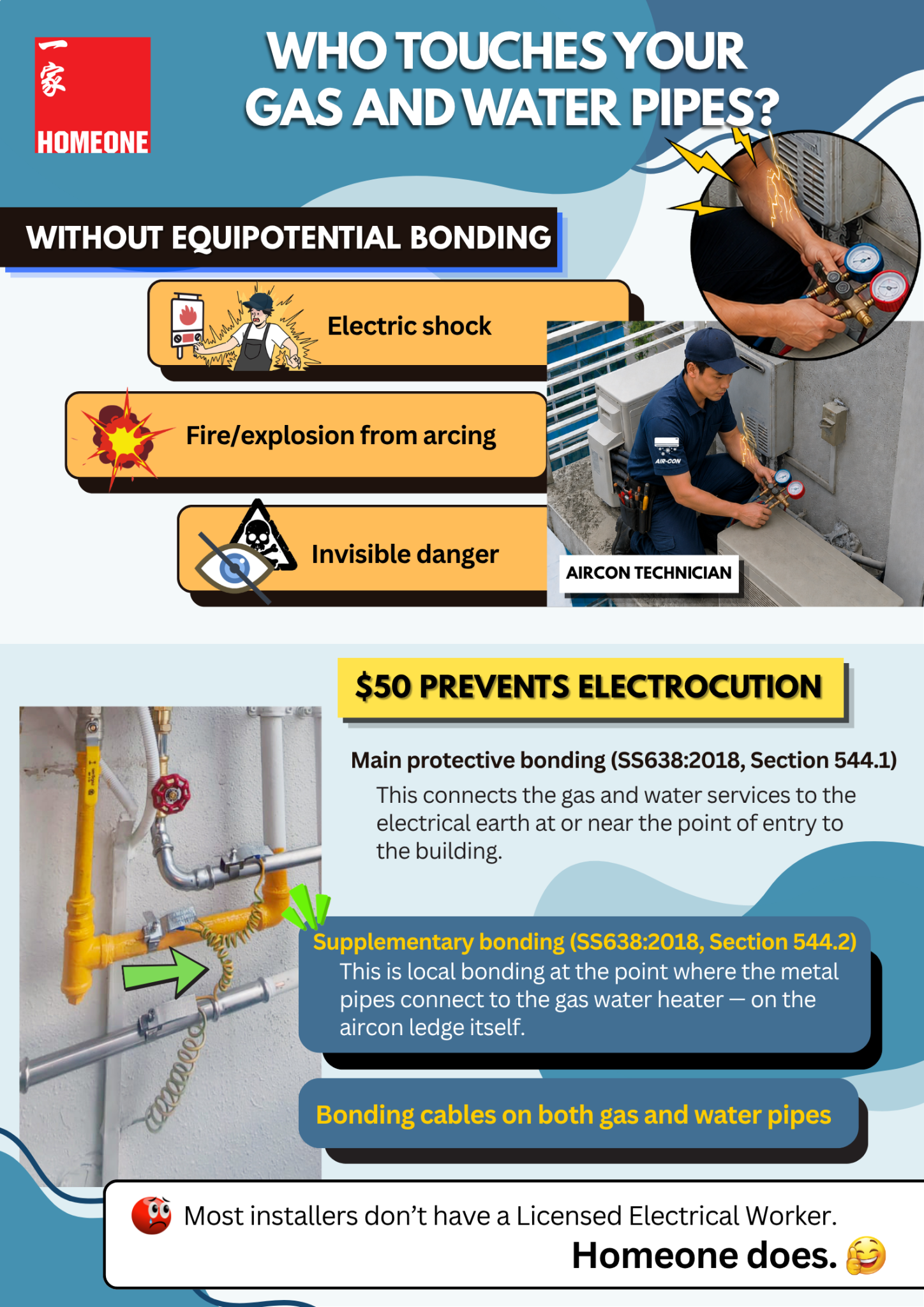
Equipotential bonding is a safety measure that connects metal pipes — gas and water — to the electrical earth of a building. It ensures that all conductive surfaces around your gas water heater are held at the same electrical potential, eliminating the voltage difference that causes electric shock and arcing. Most gas heater installers do not carry out this work. Homeone does, because it requires a Licensed Electrical Worker — and Homeone has one.
What Happens Without Equipotential Bonding
Without bonding, metal gas and water pipes can carry a voltage difference relative to other conductive surfaces. Anyone who simultaneously touches two unbonded metal surfaces — a pipe and a heater casing, for example — becomes the path for current to flow. This is how electrocution happens at a gas water heater.
When two unbonded metal surfaces at different potentials come close to each other — or are touched by a conductive tool — the voltage difference can discharge as an arc. In the presence of gas, an arc is an ignition source. This is not a theoretical risk; it is the mechanism behind a class of gas-related fires.
An unbonded installation looks identical to a bonded one. There is no visible sign that the risk is present. The voltage difference exists whether the heater is running or not, and whether anyone is aware of it or not. The danger only becomes apparent when it causes an incident.
Equipotential bonding work on gas and water pipes must be carried out by a Licensed Electrical Worker (LEW) — a separate licence from the gas and plumbing credentials most heater installers hold. Most installers simply do not have an LEW on the team. The bonding does not get done because the person doing the installation is not legally permitted to do it.
The aircon technician who services your outdoor unit is also working next to the same unbonded pipes. The risk is not limited to the heater installation itself.
The Two Types of Bonding Homeone Carries Out
Main protective bonding connects the gas and water service pipes to the electrical earth at or near the point where they enter the building. This is the primary bonding measure — it establishes the reference potential for the entire installation before any downstream work begins.
Without this, the entire run of metal pipe from the building entry to the heater is floating at an undefined potential relative to earth.
Supplementary bonding is local bonding at the point where the metal pipes connect directly to the gas water heater — on the aircon ledge itself. It ensures that the heater casing and the pipe connections are bonded to each other at the point of contact, not just at the building entry.
Both types of bonding are required. Main bonding without supplementary bonding leaves the local connection point — the most frequently touched part of the installation — unprotected.
Equipotential bonding of gas and water installations is required under SS638:2018, Singapore's standard for electrical installations. The work must be carried out by a Licensed Electrical Worker. An installation without bonding is a non-compliant installation — regardless of how the gas and water work was signed off. Most installers do not have a Licensed Electrical Worker. Homeone does.
When Homeone completes a gas water heater installation, the bonding cables are on both the gas and water pipes — main bonding at the point of entry, supplementary bonding at the heater connection. The SGD 50 is not a surcharge. It is the work that makes the rest of the installation electrically safe.