

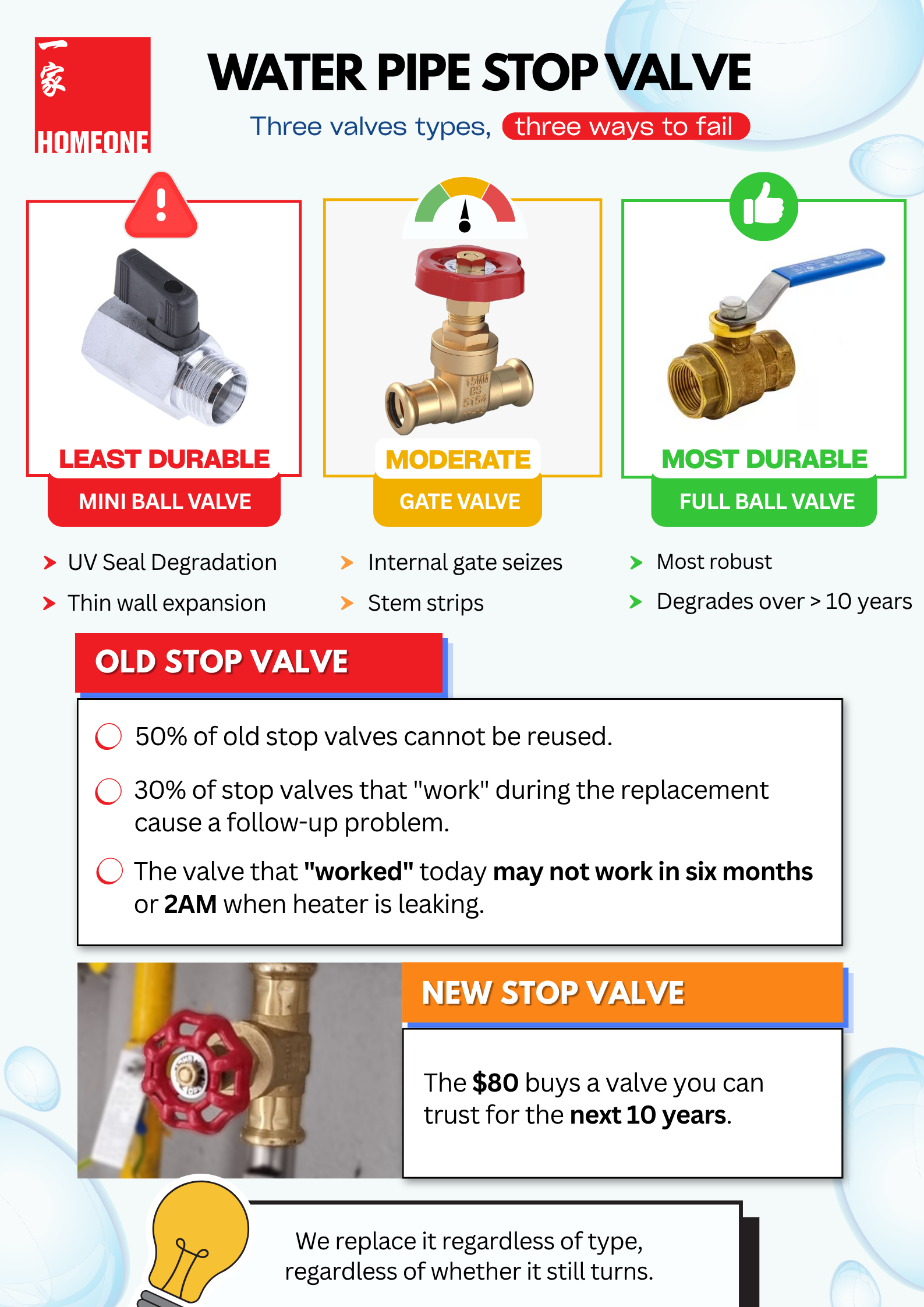
The stop valve is the single component that lets you shut off water to your heater when something goes wrong. It is not decorative and not optional — it is the first thing a technician reaches for when a heater leaks at 2AM. Most installers leave the existing stop valve in place regardless of its condition. Homeone replaces it regardless of type, and regardless of whether it still turns.
Three Valve Types — Three Ways to Fail
The most commonly installed and the least durable. Compact size means thinner walls and smaller seals — both fail faster under heat and UV exposure typical of Singapore's outdoor installations.
- UV seal degradation — the seal dries and cracks from sun exposure, causing slow leaks that are not immediately visible
- Thin wall expansion — the valve body warps under thermal cycling, eventually preventing a clean shut-off
More robust than the mini ball valve but has internal mechanical failure points that become critical over time, especially in valves that are rarely operated.
- Internal gate seizes — a valve unused for years will seize; turning it under emergency conditions risks snapping the stem
- Stem strips — the stem thread wears and strips, leaving the valve stuck open or closed with no mechanical control
The most mechanically robust stop valve available for residential water installations. A quarter-turn delivers a complete shut-off with minimal wear on the internal mechanism.
- Most robust construction — full-bore design minimises pressure drop and internal wear
- Degrades over 10+ years — the longest serviceable lifespan of the three types under Singapore conditions
The Problem with Old Stop Valves
The SGD 80 buys a full ball valve you can trust for the next 10 years. Installed new, torqued to specification, and tested before the job closes. When you next need to shut off water to your heater — planned or emergency — the valve will work.
Homeone replaces the stop valve regardless of type, and regardless of whether it still turns. A valve that turns today under no load is not a reliable indicator of a valve that will perform under emergency conditions. The replacement is not conditional on the existing valve's apparent condition.